
Continuous Creation in a Living World
By Ned Abenroth
The heavens declare the glory of God;
the skies proclaim the work of his hands.
Day after day they pour forth speech;
night after night they reveal knowledge.
They have no speech, they use no words;
no sound is heard from them.
Yet their voice goes out into all the earth,
their words to the ends of the world.
Psalm 19:1-4 NIV
One of the travesties of the Enlightenment is the poverty of living in a world we see as material. Most modern folk, even people of faith, have been taught to see the earth as something that was created in the distant past, and God is mostly separate from the universe He made. Materialism means that there is no kinship with the rest of creation, which too easily allows us to desecrate the earth without much thought.
But the beauty of all acts of creation is seen most clearly not in the ends, but in the process of emergence. Things begin to shift when you consider creation as a verb more than a noun, and more about what is unfolding now rather than a past event.
Wisdom from my own lineage holds that, in this moment, the Creator is creating all that is. Indeed, if God were ever to stop creating this universe, everything would simply disappear in the blink of an eye, like a room going dark when the light turns off. The Creator’s nature is to continually bring the world into being, from the holding and spinning of each subatomic particle to the cosmos itself. And not only physical matter, but in the inexhaustible ways it is rewoven into expressions of beauty and life.
The English language reinforces part of our impoverishment. It’s a language of empire and abstraction, made up primarily of nouns and relatively few verbs. This encourages our tendency to view the earth community as a collection of objects. Mountains, oceans, rivers, and so on are objects, not kin.
In contrast, most indigenous languages, according to Robin Wall Kimmerer, are primarily composed of verbs, with nouns used only for physical things humans make. In her book, Braiding Sweetgrass, she explains that in her native tongue, Potawatomi, a lake is not a static noun but a temporary gathering of earth and water that is actively being a lake. Standing on its shores, they wouldn’t ask, “What is that?” Neither would the answer be, “That’s a lake.” Rather, they would ask, “Who is that?” and the answer would literally translate into something like, “Lake-it-is-being.” The question of “who” honors the subjectivity of everything, and the answer being a verb reveals the current creative moment.
For us to once again live in such an enchanting world, we have to adopt a posture that lets reality out of the small boxes we’ve stuffed it in. For our good and for the good of the earth, we need to see the world:
As made up of a community of subjects, not a collection of objects,
As being born in this moment, not just long ago,
As infused with presence and spirit, not merely material,
As our kin and home, not as something we can desecrate and then abandon,
As borrowed from our descendants, not inherited from our ancestors
Of course, there is a paradoxical chicken-and-egg problem with changing one’s view of the world. For anyone to see the Creator and the universe in these ways, they must experience this perspective as the truth. But for anyone to experience the world this way, they must first believe it is so.
At their best, humans are willing to venture into a new worldview. But they need a reason to trust. What will help someone make the switch
For myself, I ask, What path adds to beauty, to mutual flourishing, to love, to wholeness? The veracity of any worldview can be seen in its fruits. An extractive, objectifying view of the world is leading us down a path of mutual destruction. It is morally bankrupt. It is a worldview that is not “true” even if it is the loudest and most common story being told.
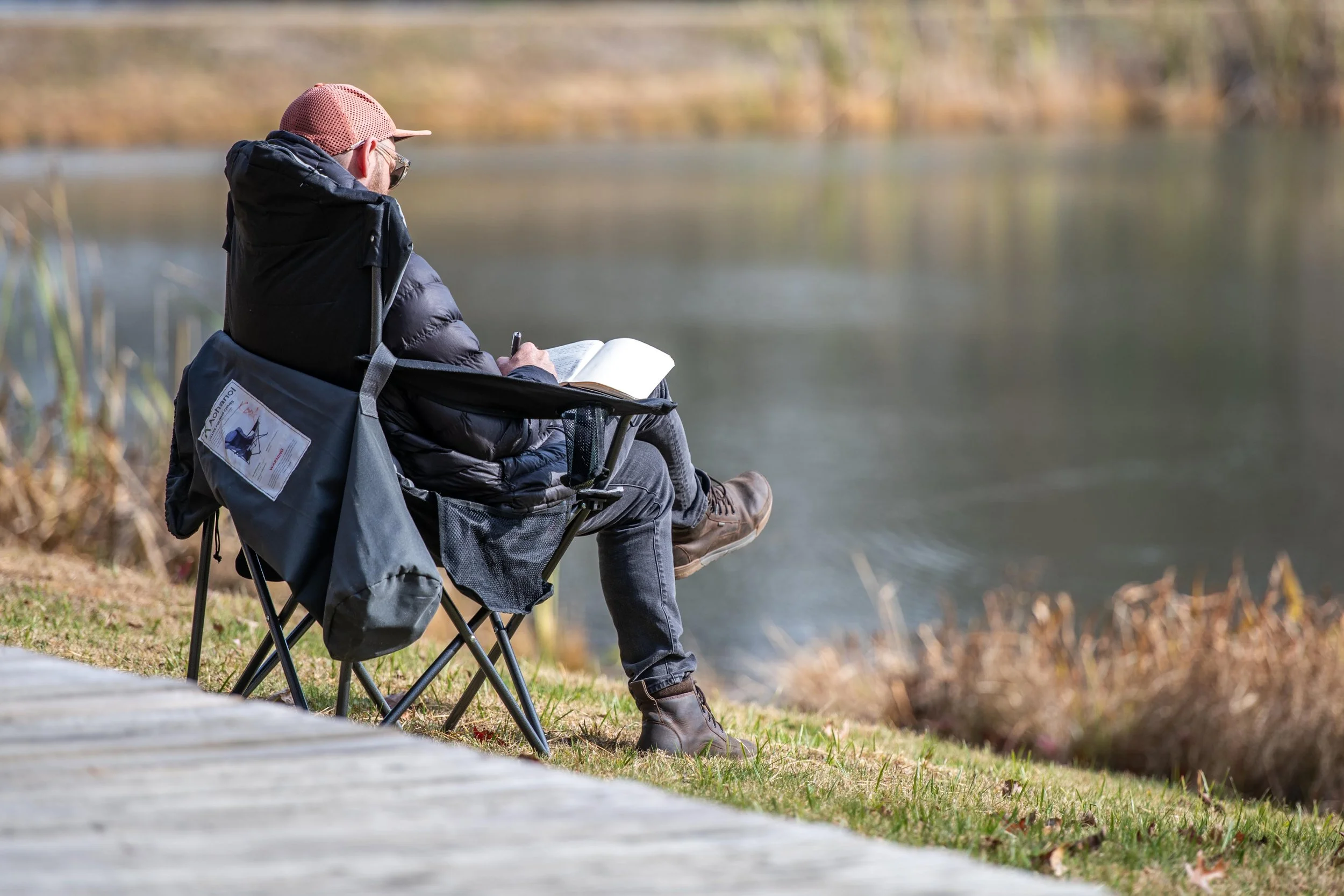
On the other hand, when I walk to the water’s edge and listen, and lift my eyes to the heavens, as the psalmist did, and linger there for a while, an ineffable sense of calm comes over me. Wendell Berry, who crossed over this month, put it this way in his 1968 poem "The Peace of Wild Things."
When despair for the world grows in me
and I wake in the night at the least sound
in fear of what my life and my children’s lives may be,
I go and lie down where the wood drake
rests in his beauty on the water, and the great heron feeds.
I come into the peace of wild things
who do not tax their lives with forethought
of grief. I come into the presence of still water.
And I feel above me the day-blind stars
waiting with their light. For a time
I rest in the grace of the world, and am free.
For me, that’s the only kind of world I can trust, and the only kind that rings true.