
Ishq Allāh Ma’būd Allāh: God is the Love, Lover, and Beloved.
By Ned Abenroth
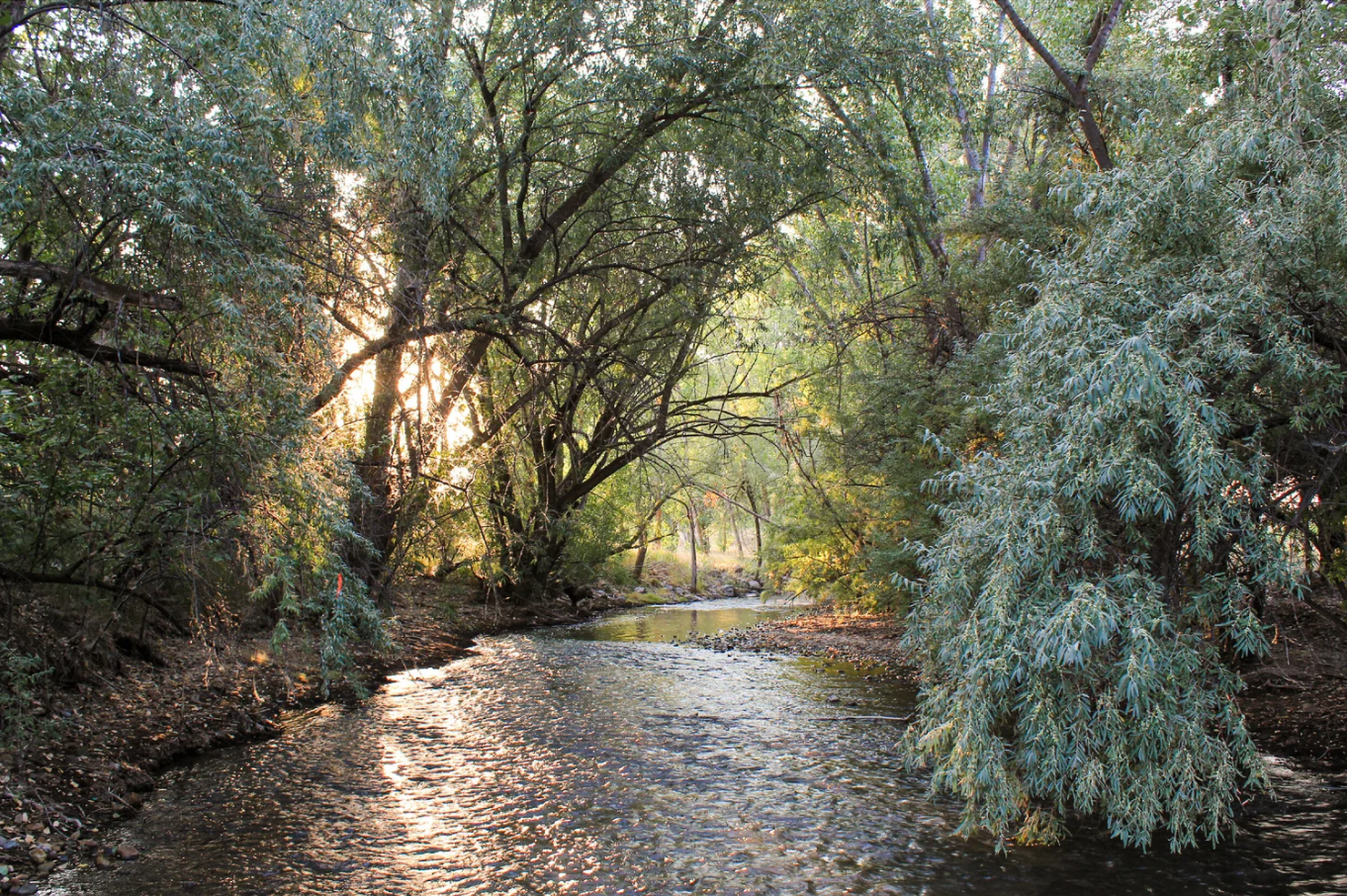
Standing beneath the dancing tree leaves on the floor of an Arizona canyon, something broke open in me. Maybe it was prompted by the sound of the wind in the cottonwoods. Perhaps it was the way the sun was both absorbed by the green leaves and passed through them, creating shimmering flickers of green against the impossibly blue sky. I’m sure it was all that and more. Whatever the case, that was the moment I finally, deeply received the grounding of my own belovedness, a moment as visceral as my earlier submergence in the Aravaipa River.
There’s nothing particularly special about my belovedness. It has been given to all of us. Yet it is an inheritance that, while belonging to us all, has not been received by most. Few people have truly internalized it, even though they know it exists. That was me, affirming at an intellectual level that I was beloved my whole life, but never knowing it, experiencing it, swimming in it. Only in that moment in my mid-thirties did I truly feel it in my bones.
When I did, it changed everything.
My ego wasn’t a fan of unconditional love when I was growing up. As a teenager, unconditional love felt like a meaningless participation prize. My ego preferred to build self-worth by guzzling the intoxicating but ultimately unsatisfying wine of achievement. I wanted to earn love, to become worthy, to excel and claim significance as my own.
There is nothing wrong with ego formation and achievement. But, ideally, it flows from one’s inherent sense of worth rather than a self-worth project. Regrettably, at fourteen I thought being respected was more important than being loved. It’s the same troubled thinking that left the prodigal son’s older brother full of resentment. Through my twenties, the more I accomplished, the hollower it felt. Part of me was desperate for God’s love, but apparently, I still didn’t think I deserved it.
Remarkably, it wasn’t for lack of spiritual experiences. I had tasted many holy moments by then. I had experienced supernatural graces that amazed me. I had witnessed births and deaths that left me with no doubt as to the presence of Love, Grace, and God.
Grace reminds us that brokenness doesn’t separate us from God’s love. Belovedness tells us that before, during, and after all things in life, we are delighted in and loved by God. Love precedes Grace and endures after it.
Grace says our sense of unworthiness is a problem that can be solved. Love says the entire category of worthiness misses the point and is too small for God’s largesse.
Grace is not about God changing His mind about us, but about changing our minds about God. God has already forgiven us; Grace is a backdoor into our minds that He uses to convince us of that, to remind us of our inextricable and inseparable connection to Him.
In heaven, when we shall see everything clearly, there may be no further need for Grace… but Love endures forever.
That day in Arizona, Love didn’t answer the question of worthy or unworthy; it simply swept the entire category down the river. It destroyed my too-small categories and left me shaking, open, and overwhelmed with gratitude. Love never invades us nor abandons us; it waits for our consent. But sometimes, if we’re lucky, it becomes fierce enough to break through our bullshit. It only needs a foot in the door to get started, and soon the barricades we’ve built don’t stand a chance.
Ultimate Love is simply another name for God. It is the core of God, not merely one attribute in a long list (merciful, just, mighty, compassionate, creative), but the prism through which all the others are understood.
Our culture wants love in a little box next to sentimentality, but Love is far more wild than the tamed versions we’ve boxed it into. Love is the force by which all things were made and are held together. It is in every atom, in the spaces between them, at the edge and in the center. It sets galaxies spinning and holds both life and death in its hands. It is the parts and the whole, intimate and universal, the first and the last.
And the awakening that rattled me in Arizona is why it matters.
Our belovedness stands on its own. We can’t increase it or diminish it, lose it or earn it. It simply abides as our enduring identity. We will forget it at times, but it remains within us, and even our forgetting serves our remembering, our appropriating, our incorporating. God loved me not because I was good, but because God can’t help himself; it’s just his nature. There was nothing I could do about it, nothing I even needed to do. It asked nothing of me, though it offered me everything.
To be sure, it makes a great difference whether we receive and accept Love rather than simply ignoring or denying it. Life is more joyful when we’re conscious of our belovedness, but that truth holds whether we accept it or not. When I finally found my way into acceptance, it released me from a life of obligations and opened a field in which my longings to create and play were blessed. I would lose myself many times again, but I would never again be lost.
I don’t usually walk around in such ecstatic bliss. Like a rock in my pocket, my belovedness is always there to touch and remember. Most of the time I live at the intersection of life’s absurdity and my belovedness, trying to hold the two together. It forces me to ask, “Even this? Even here?” Sometimes it takes a while to believe God’s yes. It takes practice.
So why am I saying all of this?
At every MROP we bless the men with oil and proclaim that each is a beloved son of God. It is my favorite part of the entire MROP, as you see a dawning realization in men’s eyes that this just might be true. To me, Illuman’s mission, “awakening men to their belovedness, that they might love the world,” is the foundation of our work.
But a man recently asked me, “How do you move from intellectual affirmation of belovedness to felt experience?”
Rumi said, “Our task is not to seek for love, but merely to seek and find all the barriers within yourself that you have built against it.” That resonates as one answer. And Mary Oliver’s poem “When I Am Among the Trees” speaks to her practice of going out into the more-than-human world and being reminded, every day, of her own belovedness. That was her path. The cottonwoods in my story were not ancillary witnesses, either. Somehow they saved me, as they did Mary, time and again.
This leads me to these questions: How have you taken in your own belovedness? What broke in, robbed you of your sorry resistances, and freed you to accept your universal inheritance? What practices and places help you keep remembering it, drawing upon it?
When I am among the trees,
especially the willows and the honey locust,
equally the beech, the oaks and the pines,
they give off such hints of gladness.
I would almost say that they save me, and daily.
I am so distant from the hope of myself,
in which I have goodness, and discernment,
and never hurry through the world
but walk slowly, and bow often.
Around me the trees stir in their leaves
and call out, “Stay awhile.”
The light flows from their branches.
And they call again, “It’s simple,” they say,
“and you too have come
into the world to do this, to go easy, to be filled
with light, and to shine.”
—Mary Oliver