
Prophecy: When Love Stands Where the World Won’t Cooperate
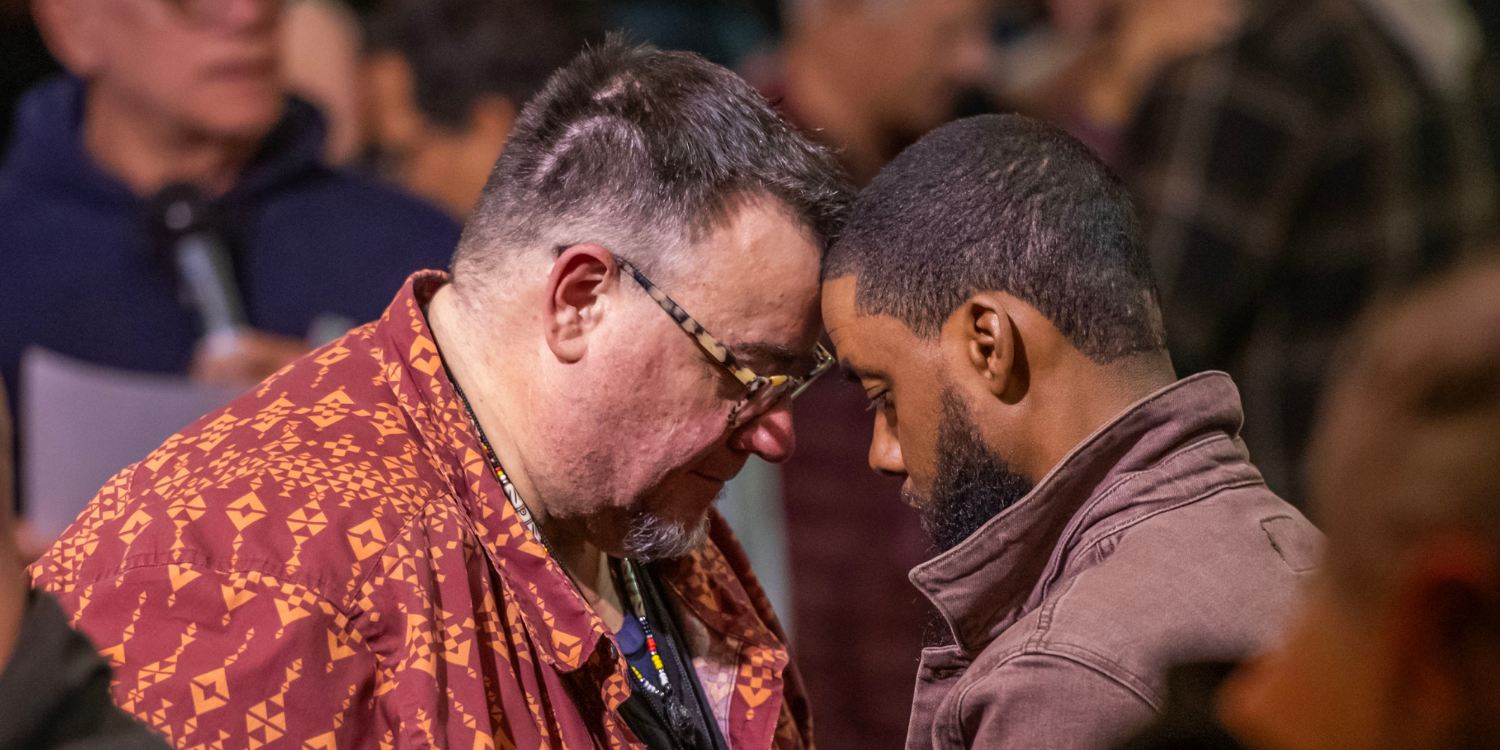
Photo by John French
January was a month of intense conflict in Minneapolis between ICE and the local community. Last year, T. Michael Rock was a guest on the podcast, and given his role as a police chaplain, local pastor, and spiritual guide in the midst of the protests, we had him back to talk about his experience on the ground. As part of our conversation, we discussed the archetype of the Prophet. This blogpost builds on the importance of this role. We talk about this as a role, and certainly, there are those who seem to carry this gift. But the underlying archetypal energy is in us all, and we all are called at times to hold it for the good of the world. Now is such a time.
There are places where the world as it is stops cooperating with our illusory beliefs of how we thought it was. At this threshold, we feel the mental divide between two things that seem irreconcilable. Some choose to take the blue pill and remain asleep; prophets take the red. This disillusionment is the doorway into healing and liberation for us all, but we may have to stay in the hard place of dysphoria for far longer than we bargained.
The desert invites awakenings like this. So do long illnesses, superfund sites, and Minneapolis neighborhoods filled with tear gas. In such places, language thins and certainty dries up. What remains is not insight so much as exposure. You realize what you assumed and depended on when the power of distraction is no match for the harshness of the vista, and you learn quickly that God has not arranged life for our convenience.
In many of his books, Illuman Elder Belden Lane invites us into landscapes, not as metaphors but as teachers and companions with wisdom to impart. It isn’t to make us feel better. Particularly fierce landscapes do not comfort, at least initially. They disorient, and hopefully, eventually, they bring a stark and stripped-down clarity. To engage them requires learning how to listen without reward, to attend without control. God in these places is not absent, but stripped of sentimentality—encountered as demand, silence, and invitation all at once.
Prophecy begins there.
Forget certainty and charisma, prophecy is born in attentiveness shaped by deprivation. The prophet is not the one who escapes the wilderness, but the one who consents to be changed by it. This kind of listening does not produce answers so much as it rearranges loyalties. It reveals to a person what can no longer be explained away. Its solace, in part, is the peace one feels from not expending loads of energy trying to suppress the sliver in the brain whispering that the official story is rotten to the core. Surrendering to truth and allowing the suffering to be what it is always takes less energy, but asks far more of us than pretending that all is well.
Only after this gauntlet does the prophet speak. When they do, their words carry the grit of the places that formed them.
A prophet is not a fortune-teller. They are not a brand, not a microphone, not a person who enjoys the sound of their own urgency. If they are anything at all, they are someone who has learned how to stay put long enough to notice when the world is lying to itself.
Walter Brueggemann says the prophet’s task is to nurture an alternative consciousness. Abraham Joshua Heschel says the prophet is one who feels the world’s pain more deeply than most, who is “somewhat embarrassed” to be alive while injustice persists. Between them, you begin to see the shape of it: prophecy is not prediction, but perception. They see both the way things are and the way things could be, or even should be. The gap between the two worlds is one they can’t abide.
The attentiveness of the prophet means they listen to grief before it becomes statistics. They listen to the land before it is exhausted. They listen to God not as an idea, but as a disturbance—an ache that won’t let them get comfortable.
Prophecy begins with an unflinching witness to the story being told. They are the first to hold up the mirror to the rest us, offering a fierce inventory as to the state of our common life.
The official story, in almost every age, insists that injustice is just the normal way of things. Perhaps the snake-oil language of “We’re doing the best we can” or “We’ll change things soon” is offered to assuage the public’s doubts. Such platitudes are seen through for what they are. The witness of the prophet refuses to cooperate and won’t be suppressed, contained, or placated by such offerings.
Heschel reminds us that the prophet is not calm. The prophet is disturbed. But not in the way of someone addicted to outrage. This is not the disturbance of noise. It is the disturbance of intimacy. The prophet has gotten too close to suffering to explain it away and too close to God’s vision for the world to settle for anything less.
Their way of seeing refuses the official story of every empire, while offering something far better. Martin Luther King’s “I have a dream” speech illustrates this simultaneous offering of vision as critique, as well as any other prophecy one might find.
Prophecy always pushes back against empire—not just political empire, but the empire of inevitability. The empire that says:
This economy is normal.
These laws must be followed.
This violence is necessary.
This despair is your own fault.
Justice will come tomorrow
The prophet says no.
No, this is not normal.
No, this is not necessary.
No, the time to address it is not tomorrow
No, this is not yours alone.
Their “no” is always held in a deeper “yes.” They have seen a more beautiful and righteous path that offers liberation and wholeness for everyone. This is the prophetic imagination in action, which is ultimately not gloomy, not full of doomsday, but full of a fierce and verdant hope in the way things could be, the way of God, the way of truth and justice for all.
I have a dream.
And they speak from inside the life of a people, not from above them. Prophets don’t hover. They belong to a place, a neighborhood, a field, a people.
That’s where Wendell Berry helps us. Berry has never pretended that wisdom floats free of fields and creeks and neighbors. He knows that truth spoken without affection for a place quickly becomes cruelty. The prophet, in this sense, loves the world enough to tell it the truth about itself.
This is why prophets so often sound unpatriotic, unproductive, and unhelpful. They are not interested in growth that forgets its costs. They are not impressed by success that requires amnesia. They refuse to call extraction a blessing.
And they grieve. Brueggemann insists on this: prophets grieve with the people before they imagine anything new. There is no alternative future without first telling the truth about loss. Lament is not weakness; it is accuracy. It is sacred desire that is inconsummate and stymied. It names what has been broken, aching with rather than covering over suffering.
Heschel goes further: the prophet’s grief is not just human sorrow; it is participation in divine pathos. God is not indifferent. God is affected. And the prophet, for reasons that are never explained, is allowed to feel that affect in their own chest.
That kind of feeling is costly. It will not make you popular. It will not make you efficient. It will not make you safe. It may cost you your life, your reputation, your personal health.
It is no wonder that prophets are rarely professionals; and even rarer still that they seek this calling out of desire. Much more often, the archetype finds them, and despite the person’s resistance at first, they end up incapable of doing anything other than being the prophet they were called to be. They are often farmers, poets, parents, exiles, troublemakers, people who would rather be doing something else. They are people who stay when leaving would be easier, and who speak when silence would be rewarded.
The prophet’s work is not to win. It is to witness and imagine. To keep alive a memory of how things could be otherwise. To remind a people of promises they have learned to manage without.
In Berry’s world, faithfulness is measured in small acts: tending a field well, staying with a marriage, refusing to abandon a neighbor. Prophecy lives there too—not in grand gestures, but in stubborn fidelity to what is real. In doing so they acknowledge the bloom as well as the broken bough, the harvest as well as the drought.
A prophet will not let us forget that the world is not merchandise, that people are not problems, that hope is not optimism, and that despair is not the final truth.
This point is essential. For while prophets might be known for the hard edge they offer, a mature one who remains connected is as joyful as they are grieved, as enchanted as they are disillusioned. Their deep faith and hope lie in a future in which Love has the final say. Their hope is in tomorrow, but they hold it with us in the present.
They are not ahead of us.
They are beside us, and sometimes even behind us, calling us back to what we already knew before we learned to live without it.
If there is a role for prophets now, it is this:
to slow us down enough to feel what we are doing,
to speak the truth without fear or shame,
to resist polarization and othering,
to honor the presence of God everywhere,
to grieve what we have normalized,
to love with wild abandon, following where Love would lead us, and
to imagine a future rooted not in escape, but in restoration.
Not louder,
not faster,
just truer.
Don’t wait for others to fill this role. It is a universal calling. Where are you called to tap into the prophet in you, for the good of the world?