
The Most Powerful Prayer a Man Can Say
By Ned Abenroth
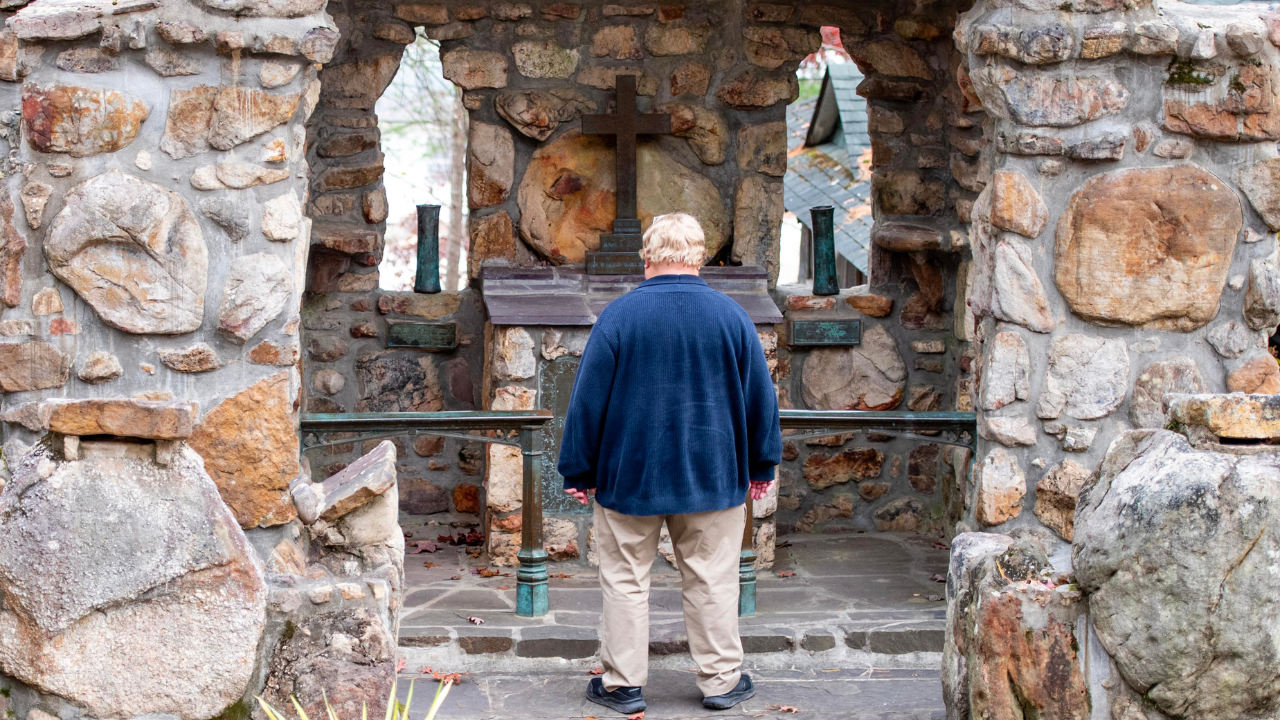
Photo by John French
A Franciscan monk, a question about power, and what masculinity might really be for.
My wife tells me most women, when asked, would rather run into a bear in the woods than a man they don’t know. Not because the bear is safe; the bear might kill them! But the bear would leave their dignity intact. For the vast majority of women, encountering an unknown man out in the woods is a far more terrifying and threatening prospect than encountering a bear.
This reality can be uncomfortable. When Jamie shared this with me, I immediately wanted to defend the goodness of men! But we needn’t argue with the legacy; the impact is worth sitting with.
Recently, I spoke with Terry Symens-Bucher for this month’s podcast, and he shared a story that has stayed with me. Years ago, Terry was praying with a group of Franciscans. During these prayers, one quiet, unassuming monk voiced a simple prayer into the gathering.
“May no one ever be afraid of me.”
It caught Terry completely off guard and left him puzzled. Who would ever be afraid of this man? The monk seemed gentle, humble, someone who wouldn’t harm a fly. It wasn’t that the monk was weak; in fact, quite the opposite. He carried a vitality and grounded strength. He bore that quality of strength that can’t be shaken, the kind that gives a man a gentle presence. He held the kind of strength that comes from long practice and years of prayer, discipline, and inner work done mostly in secret.
Furthermore, the prayer wasn’t about the man becoming small or weak, so as not to induce fear in others. Rather, this monk was consciously tending to his strength. He longed for his strength to be a blessing, not a curse. It was not a prayer of shrinking; it was a prayer of how to hold immensity in a manner that is good. It came to Terry that perhaps no one was afraid of this man precisely because he had been praying this prayer for many years. That is what made the prayer so powerful.
“May no one ever be afraid of me.”
Often, prayers seek help from God, for blessing, for aid, for healing, for protection. The monk’s mantra was less about asking and more about a habitual bringing to mind the work needed for the prayer to become a reality. It was more an offering, a dedication and an intention than a request. A prayer that you pray day in and day out is formational, more than transformational, and you might not notice the difference at first, but over the months and years, it will shape you.
Terry told me it was the most powerful prayer he had ever heard, “the most powerful prayer a man can say.”
From a brain science perspective, where we place our attention becomes our destiny, as neural pathways we repeat again and again, for better and worse, become deeper and deeper ruts. We can ingrain into ourselves habits that trend towards wholeness or habits that reinforce wounded ways of being in the world. So it isn’t the exact words, of course, that held the power; it was because the prayer had clearly been a familiar path for this monk, being formed over time, through which a man’s strength was initiated into a power that can be a blessing.
The most powerful prayer a man can say is the one he will offer himself to in order for it to bear fruit. It is the prayer he will pray again and again and again.
And what about the bear?
Sadly, this monk’s idea of holding power hasn’t penetrated deep enough into our culture. Women still prefer the bear over the unknown man. We have a legacy of thousands of years we have to work through. When we sit with the harm men have done, let’s take a breath.
When facing the litany of harms men have participated in, masculinity doesn’t need defending. Nor does it need to be attacked, inflated, or praised. More than anything, masculinity needs initiation.
Across cultures and throughout history, the maturation of men has almost always involved some form of initiation—a journey that takes a man into powerlessness, surrender, and loss. These rites of passage interrupt the illusion that strength is about domination or control. They crack a man open, and in that cracking open, something deeper begins to rearrange the order of things.
The initiated man learns to stay in that wide-open space long enough for his heart to grow larger. The larger the crack, the longer he remains, the more his heart will grow. Empathy grows there; compassion grows there; the capacity to hold both strength and tenderness grows there.
In this crucible, he is formed—not just as an individual, but as a member of a community of initiating men. This community helps shape how masculine power will be used. The question of what it means to be a man can never be answered independently from a group who are asking, what does it mean to be men? It is not a solo journey, but one discovered in community. And the quality of their response shapes the next generations of men. Men do not generally develop by contemplating values on their own, but by rubbing shoulders with other men.
We see this pattern of initiation across cultures on every continent. Where healthy initiation traditions exist, when true elders are present, masculine power is guided toward responsibility and service. Where those traditions disappear, young men still seek initiation, but often in distorted forms. Street gangs, violent subcultures, and extremist movements frequently function as substitute initiation systems.
Healthy or unhealthy, at the root of all initiations lies the same two questions: Who are you, and what are you supposed to do with your power? The answer to the former always places the man in a larger communal frame, granting a healthy identity. In Illuman, we name this identity very clearly, “You are a beloved son of God.” The answer to the latter question then orients him towards service to the larger realm.
Uninitiated power tends to revolve around the self. It seeks validation, dominance, and control. Sometimes it expresses itself through aggression, other times through withdrawal, resentment, or manipulation. Regardless, it remains centered on the ego.
Initiated power looks very different.
Initiated power becomes protective rather than threatening,
steady rather than reactive,
capable of holding space rather than needing to dominate it,
prophetic rather than capitulating,
flexible rather than rigid.
In other words, power becomes trustworthy.
“May no one ever be afraid of me.”
The monk did not live this prayer because he believed himself incapable of causing harm and simply wanted others to view him differently. He said it because he knew he was absolutely capable of it, as we all are. The difference came by allowing that raw power to be formed over the years by humility, prayer, and community, tending to the cracks in a rhythm of ongoing transformation.
When you follow this path, something subtle begins to change.
People relax around you.
Children feel safe near you.
Women do not instinctively calculate their escape routes.
Other men feel less of a need to posture or compete.
Your strength is still present, but it carries a different quality. It does not press outward. It holds. This is the quiet fruit of initiation, and perhaps that is what the monk’s prayer ultimately expresses. Not a desire to become harmless or passive but a commitment to ensure that whatever strength lives within you becomes a force that protects rather than threatens. A force that makes “good trouble” in the presence of injustice. A force that stands in solidarity with the oppressed.
We can call that force by its best and highest name, love. For this force is not about taking, but giving. One great teacher put it this way, “No one shows greater love than when he lays down his life for his friends.”
And who is your friend then? Well, in the grand scheme of things, who isn’t?
What is the prayer you are willing to dedicate yourself to? What is the “vow that would kill you to break?” How will you carry your own power today? For whom and what are you willing to give your life?