
Why There’s No Single Way to Be a Man
By Ned Abenroth
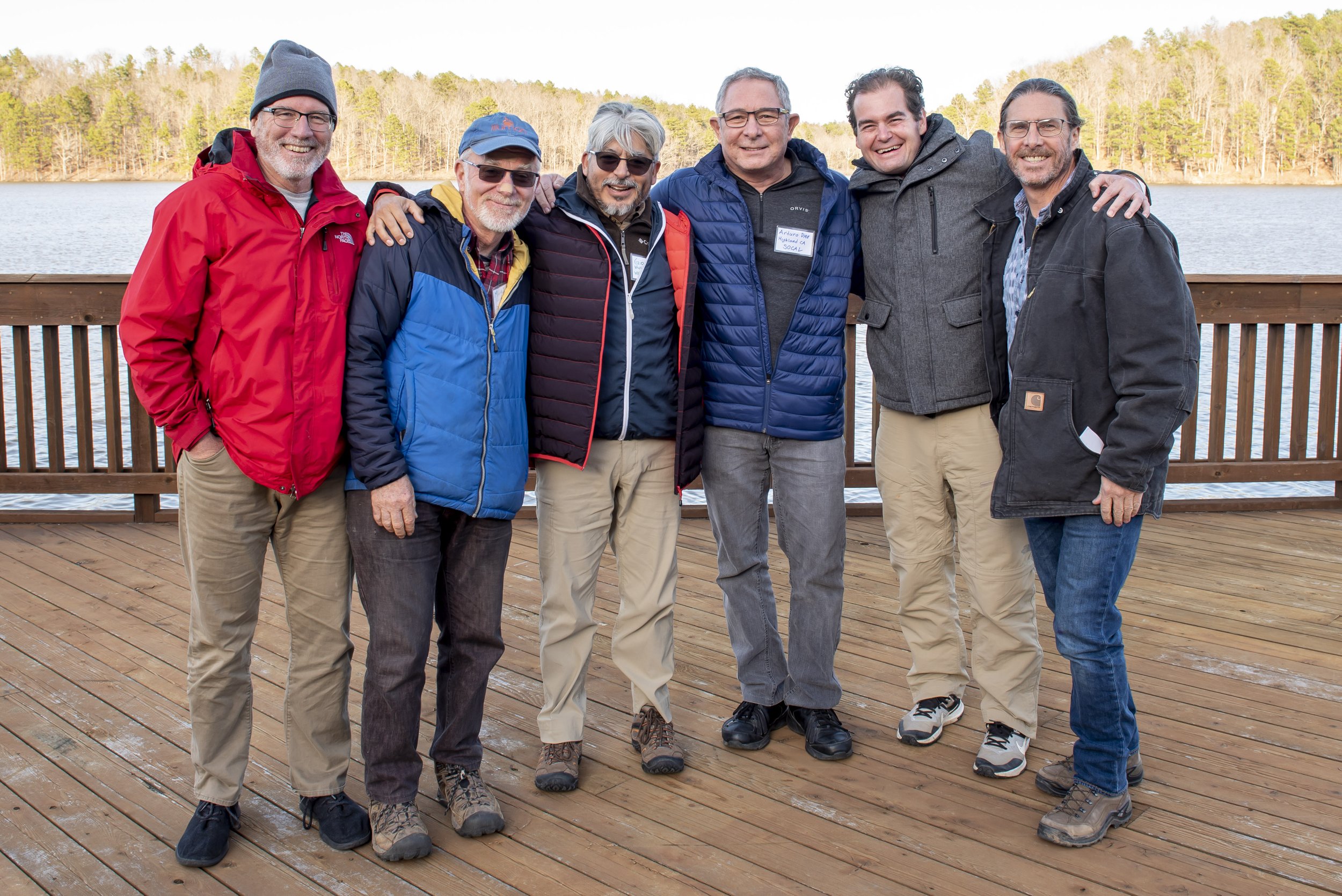
Photo by John French
There is a question that haunts men's work, and it goes something like this: What does it mean to be a man?
Attempts to define masculinity often rely on archetypes such as the warrior, lover, magician, or king. Or on benchmarks such as being a provider, protector, or progenitor. While these models may contain some truth, they simultaneously limit a broader understanding. The core problem is this: the instant we try to rigidly codify what masculinity is, we also inherently define what it is not. Both forms of crystallization are problematic.
Scholars who study gender have largely moved away from speaking of masculinity as a single thing. They speak instead of masculinities. Plural, situated, always in relationship to culture, class, body, and history. What it means to be a man in one context flowers differently than it does in another. This isn't relativism. It's honesty about what we actually observe when we stop trying to force a single image onto a wildly diverse reality.
But the plural noun still doesn't quite capture it. Masculinity is not only diverse across men; it is also always in motion within a man. It is less a fixed point than a rhythm. Less a noun than a verb.
Let’s look at an example from nature.
Physicists discovered something strange about light: it behaves like a particle when you measure it one way, and like a wave when you measure it another. It isn't one or the other. In some fundamental sense, it is both. Which one presents in a given moment depends on how you look at it.
Masculinity is something like this. In any given man, it shows up as something particular and located: this body, this history, this gift. But it is also always moving. The tide comes in; the tide goes out. A man is fierce and then tender. He leads, and then he follows. He speaks, and then he falls silent in a way that holds more than words could. The mistake is to freeze one moment of the wave and call it the whole truth. Masculine vitality lives not in any fixed position but in the entirety of the dance. It includes both knowing when to advance and when to yield, when to build and when to destroy, when to act and when to simply be present.
My favorite story of all time, Tolkien's The Lord of the Rings, gets at this.
Consider who Tolkien assembles for the most important mission in the history of Middle-earth. It is not an army of identical warriors. It is not nine versions of Aragorn. It is nine radically different beings: different in species, stature, age, gift, and disposition, each of whom contributes something the others cannot.
What if that's not just a narrative device? What if Tolkien was showing us something true about how transformation actually works, and, in particular, something true about men?
If we are looking for a general understanding of masculinity, instead of asking, "What does it mean to be a man?" we gain much richer insights by asking the plural question: "What does it mean to be men?" The collective view offers a more complete understanding than any individual element.
One of the things I've become increasingly skeptical of in men's work is the vision of wholeness that subtly flattens everyone. You know the version: become the full man by integrating all four archetypes, ascending through all the developmental stages, completing The Hero's Journey, as laid out by Joseph Campbell. It's well-intentioned, but it quietly assumes that wholeness looks the same in everybody. It assumes we are all trying to arrive at the same destination and are simply at different stages of the journey. Also muddying the waters is that Campbell’s Hero’s Journey centers the individual, not a group.
The Fellowship of the Ring offers a collection that resonates as more true.
Frodo: The Unlikely Carrier
Not the biggest, not the strongest, not the most skilled. A homebody by nature. And yet the Ring can only be carried by the one least corrupted by the will to power. Frodo's masculinity is one of radical vulnerability and endurance. His gift is not force; it is that he can bear what destroys others. How often do we undervalue that in men?
Samwise: The Faithful Companion
Sam is arguably the most heroic figure in the entire story, and his heroism looks nothing like what we typically call heroic. He tends. He feeds. He carries. He weeps and keeps going. His love for Frodo is fierce and unashamed. Sam embodies a masculinity of devoted care, and it saves the world.
Gandalf: The Elder Who Holds the Arc
Ancient, unhurried, bearing wisdom that can't be transferred, only received when a man is ready to receive it. Gandalf knows things he cannot explain. He holds the larger story when others have lost sight of it. This is an elder's masculinity, not a younger man's strength, but something riper and harder to name. Watch how he moves: thunderous at the Bridge of Khazad-dûm, then gentle with the frightened hobbit at the edge of the Shire. The same man, different currents.
Aragorn: The Reluctant King
Here is the warrior-king, and even he is not straightforwardly that. His journey is one of accepting an identity he has spent decades avoiding. His masculinity is not performed; it is slowly inhabited. He doesn't stride into kingship. He is drawn toward it and finally receives it. And he is most kingly not when he commands armies but when he kneels beside a dying man.
Boromir: The Man Who Fell and Died True
Boromir is the most painful figure in the Fellowship, and perhaps the most important one for men to sit with. He is capable, courageous, and deeply devoted to his people. He is also the one who breaks. The Ring finds the place in him where love of his homeland curdles into grasping, and he fails Frodo in the worst way. But his story does not end there. His redemption comes not in power but in sacrifice, dying to protect Merry and Pippin, spending his last strength on an act of pure devotion. He does not die as the man he wished he had been. He dies as the man he actually was, at his best. That is a different kind of teaching.
Legolas & Gimli: The Unexpected Brothers
Two men, an elf and a dwarf, who should be enemies, become something like brothers. Their masculinity is forged across difference. They make each other larger. Gimli, proud and fierce, weeps at the beauty of the caves of Aglarond. Legolas grows quieter and more rooted. Neither becomes the other, but both become better versions of themselves in the presence of the other. This is what the rhythm of brotherhood does: it doesn't flatten you into your companion, it calls out in you what was always there but couldn't surface alone.
Merry & Pippin: The Ones Who Grow Into Themselves
They begin as comic relief, loyal, bumbling, and unserious. They end up doing something individually that no one else in the Fellowship could have done. Not because they became Aragorns. Because they became, finally and fully, themselves.
Here is what strikes me about this fellowship: if any one of them had looked at Aragorn and said, that's what a man looks like, I need to become that, the quest would have failed. Frodo cannot carry the Ring and be Aragorn. Sam cannot be Sam and simultaneously be Gandalf. Even Boromir's tragedy is, in some ways, the story of a man trying to hold a fixed position—strength, strategy, the will to power—when the moment called for something else entirely. His redemption is the moment he stops grasping and simply gives what he has. The mission required each of them to be, as fully as possible, exactly who they were, and to move as that person: advance and yield, break and recover, be both particle and wave.
It is said that community is the possibility we can't achieve alone. This is partly about support and accountability. But it's also about something more mysterious. When I am shoulder to shoulder with a diverse group of men, men whose masculinities flower differently than mine, and who are each in different phases of their own inner rhythm, I begin to understand something about my own form of it that I could not see in isolation.
The Fellowship didn't just accomplish a mission together. They revealed each other to themselves, and far more about masculinity as a collective than any one of them could alone.
Masculinity flowers differently in different bodies. The goal is not to look like that man over there. It's to look like me, to be all of me.
One of the great wounds in men's formation is that we've been handed a single image of what a man should be: fixed, solid, immovable. Then we spend our lives either straining toward it or feeling diminished because we couldn't hold that pose. We've been trying to be Aragorn when we were made to be Sam. Or Gandalf. Or Pippin. And the world—the actual world, not the fantasy—needs all of them, including Boromir.
So, the question we need to stop asking is what does it mean to be a man, at least in the singular, and at least as though the answer were a fixed thing. Scholars figured part of this out a generation ago: the moment you pluralize the word, something opens up. Masculinities. Many. Rooted in different bodies, different histories, different gifts, different wounds.
But even the plural noun isn't quite enough. Because the deeper truth is that masculinity is not just diverse. It is alive. It moves. It breathes in and breathes out. It is fierce, and then it is tender. It builds, and then it grieves. It is like light itself, both particle and wave, and the attempt to pin it to one or the other is where the trouble has always begun.
The only version of the question equal to that reality is the one we ask in community, together, in the presence of all the different ways masculinity has taken root and flowered and is still moving in the varied souls around us. We ask it not to arrive at a definition, but to keep discovering, in each other, and in ourselves, what we were each made to carry, and how.
Be you today. It is all you can be. It is what you are called to be. It is all we need you to be.